
‘How long do your dreams last?’ or ‘Do you think people can remember their dreams?’ & ‘Are you suffering from any sleep disorders?’
If you’re also curious to know the answers to these questions, you are at the right place.
Dreams often leave us puzzled. It is difficult to understand the dream themes and the dream content at times.
Quick answer: a single dream usually lasts anywhere from a few seconds to around 20–30 minutes. Most vivid dreams happen during REM sleep, which returns roughly every 90 minutes. REM periods are short early in the night and grow longer toward morning, so your longest dreams usually come just before you wake up. Over a full night, most people have several dreams but remember only one or two, if any.
| Question | Short answer |
|---|---|
| How long does a dream last? | From a few seconds to roughly 20–30 minutes; most are on the shorter side |
| When are dreams longest? | In the last REM periods of the night, close to waking up |
| How many dreams a night? | Usually 4–6 dreaming periods, often with several dream scenes in each |
| Total dreaming time per night | Around 2 hours for an adult sleeping a full night |
| Does dream time match real time? | Roughly yes — dreams usually only feel longer or shorter |
How Long Do Dreams Last?
The length of a dream varies greatly. It is difficult to predict how long you might be dreaming. But experts have tried to study and provided an estimate as the answer to this question.
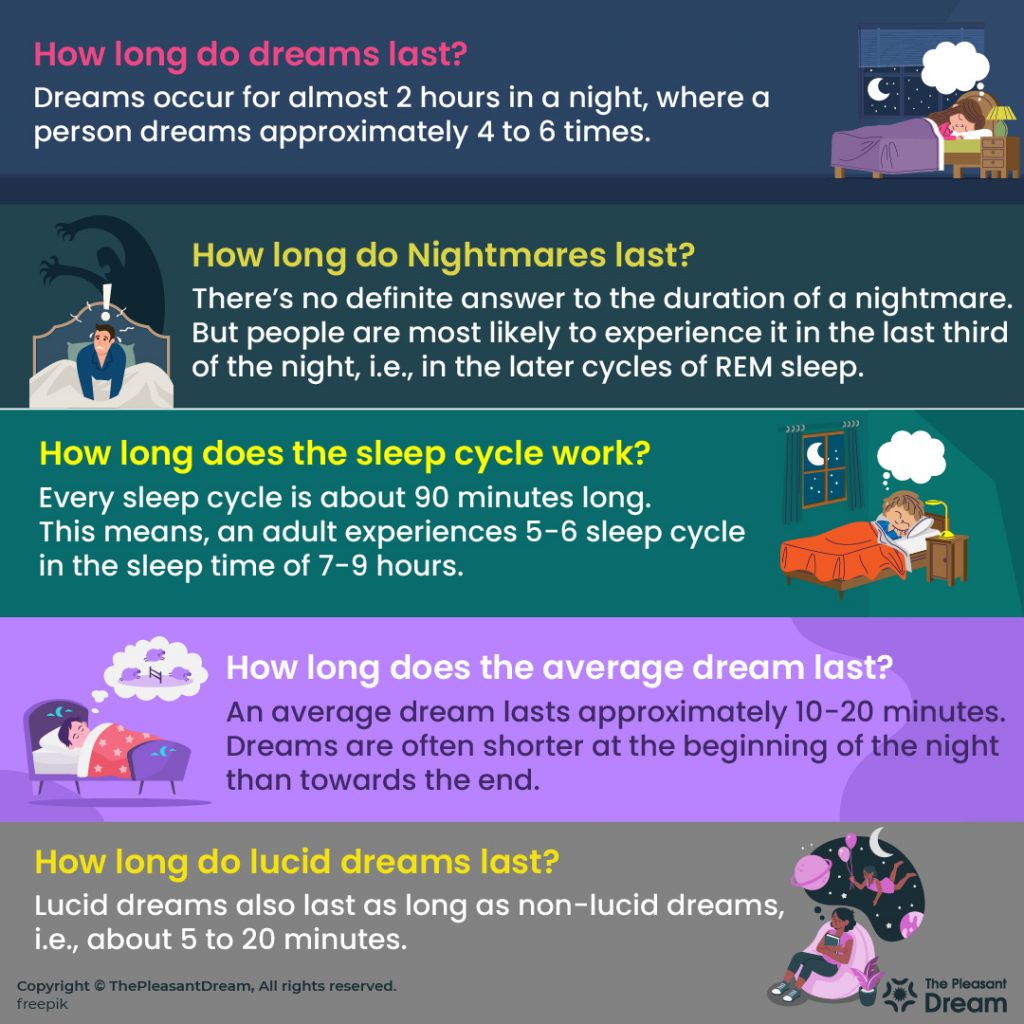
The study of the National Sleep Foundation mentions that a person can dream approximately four to six times in a night. This means a person spends around 2 hours a night dreaming.
How long do Nightmares last?
Nightmares are the bad dreams that often trigger negative emotions and can also disturb our sleep at night. According to the study conducted by The American Academy of Sleep Medicine, 50-85% of men and women have reported having nightmares.
We don’t have an exact answer to how long a nightmare lasts. But dream experts say that we experience most nightmares in the last third phase of REM sleep.
How many dreams do you have a night?
You can never keep a count of how many dreams you have in a night. Why? Because you don’t remember your dreams. You only remember some fragments of your dreams that occurred in your REM sleep.
How long do lucid dreams last?
Lucid dreams are said to occur when you’re stuck between your REM sleep and being awake. Even though lucid dreams are rare, some people can have more lucid dreams than others.
Lucid dreams last as long as our non-lucid dreams i.e., 5-20 minutes long. For some, lucid dreams are only for a few seconds and some can experience lucid dreams even for an hour. This totally depends on your control over the brain.
How long does the average dream last?
Sleep runs in cycles of roughly 90 minutes, and each cycle ends with a period of REM sleep, when most vivid dreaming happens. If we sleep for around 8-9 hours, then we undergo 5-6 cycles of REM sleep.
The first two cycles of REM sleep hardly last for 5 minutes. Then after, in every cycle, this time period keeps on increasing. As we age, our time span of REM sleep keeps decreasing.
So, ultimately, when we calculate the time duration, we know that the average dream lasts for hardly 10-20 minutes. The dreams are shorter in the first part of the night and with time, it keeps getting longer.
How Long Does a Dream Last in Real Time?
A dream can feel like it lasted days, but in real time it plays out over minutes. Sleep researchers have tested this with lucid dreamers, who can signal from inside a dream by moving their eyes in a pre-agreed pattern. When these dreamers counted or performed simple actions in the dream, the time between their signals was close to how long the same thing takes awake, and sometimes a little longer.
So time inside a dream does not really speed up. What changes is how the dream is remembered. That is why a dream that seems to cover a whole holiday may have lasted only a few minutes on the clock.
Why Do Dreams Feel So Long?
Several things make short dreams feel long:
- Scene jumps: dreams skip from one place to another without the travel in between, so your mind fills in the gap with a sense of time passing.
- Story-building on waking: when you wake up, your brain stitches the fragments together into a story, and stories feel longer than the bits they are made of.
- Several dreams merged into one: you may remember pieces from more than one REM period and recall them as a single long dream.
- Strong emotions: frightening or exciting dreams, like intense moments when awake, tend to feel stretched out.
- A long REM period: dreams just before your alarm can genuinely be among the longest of the night.
Very lifelike, detailed dreams are often called vivid dreams, and these are the ones most likely to feel like they went on for hours.
How to Remember More of Your Dreams
Because you forget most dreams within minutes of waking, it is hard to know how many you had. These simple habits help you recall more of them:
- Keep a notebook or your phone next to the bed and write down the dream before you do anything else.
- Stay still for a moment after waking. Moving and checking messages makes the dream fade faster.
- Write down feelings and fragments, even if you cannot remember the full story. Small details often bring back more of the dream.
- Get enough sleep. The longest REM periods come late in the night, so cutting sleep short cuts out your longest dreams.
- Remind yourself before sleep that you want to remember your dreams. Many people find this simple intention helps.
Why are some dreams longer than others?
Some dreams are longer than others because of the REM sleep theory. So, if you’re in your third REM cycle of the night, you’ll have a longer dream than the second REM cycle of the night.
This is because the night progresses, the time span of REM sleep also increases and that’s why the dreams you see in the latter part of the night are longer than the dreams at the beginning of the night.
How long does the sleep cycle work?
Before getting into one REM sleep, a person undergoes three NREM sleep stages. In the first stage of NREM, which is just after a person falls asleep, the eyes move slowly and the body feels relaxed. This is the lightest form of sleep and lasts for around 5-10 minutes.
In the second NREM stage, it is difficult to wake a person. Only if you make some loud noise, a person wakes up but will still be drowsy. The brain responds very slowly.
Now, in the third stage of NREM, a person is in deep sleep. The eyes and muscles show no movement. Even if you do some activity in the same room as the person is sleeping, he would not be able to notice it.
If we talk about REM sleep, it lasts between 5-45 minutes. A dreamer wouldn’t wake easily in this phase. The eyes and muscles will show no movement but the body and brain remain active since we are dreaming.
How Long Do Dreams Last? FAQs
How long do dreams last in minutes?
Most dreams last from a few seconds up to about 20–30 minutes. Dreams early in the night are usually the shortest, and those in the last REM periods before waking are usually the longest.
Can a dream last all night?
No. Sleep moves in and out of REM in cycles, so dreaming comes in separate periods spread through the night. It can feel like one long dream when you remember pieces from several of these periods together.
Can a dream last only a few seconds?
Yes. Some dreams are only brief images or moments, especially when you are drifting off to sleep or in lighter stages of sleep. These short dreams are rarely remembered.
Do you dream every night?
Almost everyone dreams every night, even if they remember nothing in the morning. Not remembering a dream usually means you forgot it, not that you didn’t have one.
Why do I remember my dreams only when I wake up suddenly?
You are most likely to remember a dream when you wake up during or right after it, for example because of an alarm. If you wake later, the dream has usually faded. To learn more about why the brain dreams at all, read why we dream.
Final Thoughts!
Well, no matter how long or short your dream has been, if you remember the content in it, you can identify some deep hidden messages from your subconscious.
So, the next time you dream, make sure you note down as many details as possible. This way you’ll be able to find the right interpretation and also act on it wisely.
If you want to know ‘What do dreams look like?’ then click here.